

Identity area
Reference code
Title
Date(s)
- 1857 (Creation)
Level of description
Collection
Extent and medium
1 print 440x550mm
Context area
Name of creator
Biographical history
Henry Grant Lloyd (1830-1904), artist, was born on 6 January 1830 at Chester, England, son of Lieutenant Henry Lloyd, Bengal Native Infantry, and his wife Charlotte, née Williams. His father retired to Van Diemen's Land in 1840 and bought land at New Norfolk, which he named Bryn Estyn after the family home in Wales. Henry Grant became a divinity student at Christ's College, Bishopsbourne, Tasmania, but in 1851 Bishop Nixon decided that he was not a suitable ordinand. In 1846-57 Lloyd sketched in Tasmania and by 1858 was painting in New South Wales. He was influenced by Conrad Martens and was probably one of his pupils. Lloyd painted sporadically in Martens's style until the 1870s but could not subdue his own spontaneous vision. In artistic style and temperament he was perhaps closer to Samuel Elyard than to the accomplished Martens. Lloyd may also have been influenced by J. S. Prout. For more information see : http://adb.anu.edu.au/biography/lloyd-henry-grant-4030
Immediate source of acquisition or transfer
Presented by Dr John Clemente
Content and structure area
Scope and content
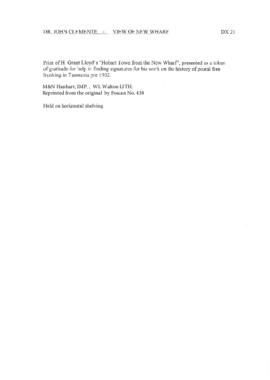
Coloured print Lloyd, Henry Grant, 1830-1904 :Hobart town from the new wharf.
W.L. Walton lith; H. Grant Lloyd del. [London, M & N Hanhart, ca. 1857].
Reprinted from the original by Foscan No. 438
Appraisal, destruction and scheduling
Accruals
System of arrangement
Conditions of access and use area
Conditions governing access
Conditions governing reproduction
This material is made available for personal research and study purposes under the University of Tasmania Standard Copyright Licence. For any further use permission should be obtained from the copyright owners. For assistance please contact Special.Collections@utas.edu.au
When reusing this material, please cite the reference number and provide the following acknowledgement:
“Courtesy of the UTAS Library Special & Rare Collections”
Language of material
Script of material
Language and script notes
Physical characteristics and technical requirements
Finding aids
Existence and location of originals
Existence and location of copies
Related units of description
Alternative identifier(s)
Access points
Subject access points
Place access points
Name access points
Genre access points
Description identifier
Institution identifier
Rules and/or conventions used
Status
Level of detail
Dates of creation revision deletion
Language(s)
Script(s)
Sources
Digital object metadata
Latitude
Longitude
Media type
Image
Mime-type
image/tiff