

Identity area
Reference code
Title
Date(s)
- 1814 (Creation)
Level of description
Collection
Extent and medium
1 paper certificate
Context area
Name of creator
Biographical history
Andrew Gatenby (1771-1848), farmer, was born at Scarborough, Yorkshire, England. He married Hannah, née Maw, of Whitby, and leased Barton farm, near Whenby in the North Riding of Yorkshire, for some time before 1812 when he moved to Wales and occupied a farm, Talymaes Park, in Grwyne Fechan, Breconshire. Depressed farming conditions and a high rental caused him to emigrate to Van Diemen's Land, and he sailed with his family in the Berwick, arriving in Hobart Town in June 1823. Andrew was granted 1500 acres (607 ha) which he selected on the Pennyroyal Creek (Isis River) and named Barton. By 1825 the Gatenby family had erected a substantial flour-mill, using millstones they had brought with them to the colony, and cut a canal and banked a reservoir to supply the mill with water from the Isis River. This mill served the surrounding district for fifty years. They built the Barton homestead by 1828. For more information see: http://adb.anu.edu.au/biography/gatenby-andrew-2083
Immediate source of acquisition or transfer
Deposited by R.L.Gatenby
Content and structure area
Scope and content
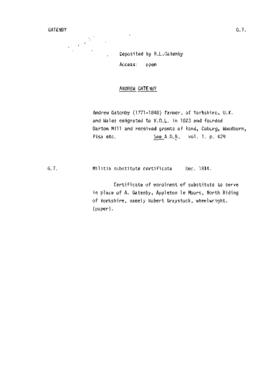
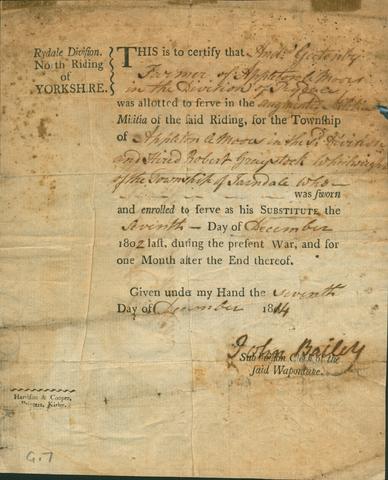
Militia substitute certificate dated December 1814. Certificate of enrolment of substitute to serve in place of A. Gatenby, Appleton le Moors, North Riding of Yorkshire, namely Robert Graystock, wheelwright. Until the 19th century militia units were used in home defence and maintaining law and order in vulnerable locations such as Ireland and the south coast of England. Militia units did not have to serve overseas, but they were seen as a useful reserve of trained men. Bounties were offered to militiamen who exchanged into the regular Army for overseas service.
Many of the men serving in the militia were substitutes serving on behalf of those whose names had been drawn in the county ballot. These substitutes often made a charge for taking over the duties. When the militia was fully embodied on a permanent footing during periods of war, a higher figure could be demanded and obtained. The regiment benefited by receiving experienced soldiers instead of raw recruits.
.
Appraisal, destruction and scheduling
Accruals
System of arrangement
Conditions of access and use area
Conditions governing access
Conditions governing reproduction
This material is made available for personal research and study purposes under the University of Tasmania Standard Copyright Licence. For any further use permission should be obtained from the copyright owners. For assistance please contact Special.Collections@utas.edu.au
When reusing this material, please cite the reference number and provide the following acknowledgement:
“Courtesy of the UTAS Library Special & Rare Collections”
Language of material
Script of material
Language and script notes
Physical characteristics and technical requirements
Finding aids
Existence and location of originals
Existence and location of copies
Related units of description
Alternative identifier(s)
Access points
Subject access points
Place access points
Name access points
Genre access points
Description identifier
Institution identifier
Rules and/or conventions used
Status
Level of detail
Dates of creation revision deletion
HE Jan 2018
Language(s)
Script(s)
Sources
Digital object metadata
Latitude
Longitude
Media type
Image
Mime-type
image/tiff